
-
My reflections on our cancer service accessibility research

Earlier this week I did my first session with a disability group for our cancer services access study (find out more about that here). Although I cannot share any of the people’s really powerful insights here I would like to share how I felt about the session. The start of the session was very ADHD…
-
Stories from across the “double rainbow”: trans and non-binary Autistic narratives [plain language summary]
![Stories from across the “double rainbow”: trans and non-binary Autistic narratives [plain language summary]](https://autisticltd.co.uk/wp-content/uploads/2023/01/326971808_911532346534071_2847542650747188154_n.jpg)
In my research I spoke to 13 trans and / or non-binary Autistic people (people said to live under the double rainbow of neurodivergence and queerness). I wanted to know about their lives, what they thought about representation and their recommendations for double rainbow research. It was important for me to do this work as…
-
Trans and Autistic: Accessing gender identity healthcare
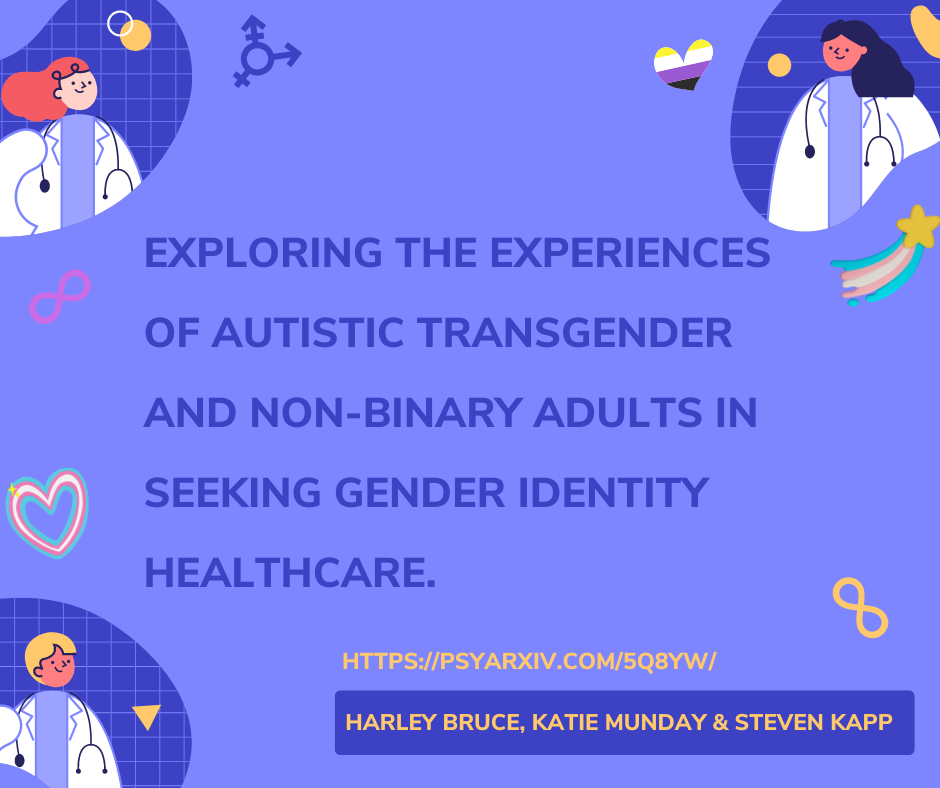
I’m excited to finally be able to share a paper I have been working on with Harley Bruce and Steven Kapp entitled: Exploring the experiences of Autistic transgender and non-binary adults in seeking gender identity healthcare. Harley spoke to 17 Autistic trans and / or non-binary people from across the globe to better understand the…
-
Navigating the Confusing PhD Application Process

Navigating the PhD application process is convoluted, heavily reliant on administrative skills, and often leads to mismatched supervisory teams. The experience highlights systemic barriers, including racism and classism, that deter applicants, especially neurodiverse individuals. The author expresses frustration with the bureaucratic hurdles that hinder deserving candidates and emphasizes the need for inclusive research representation.
-
Trans and Autistic: no coercion, only care
There is a strange fear around trans young people transitioning. So much of this is based in ignorance and very little understanding on the systems which support said young people. The words ‘coercion’, ‘forcing’ and ‘grooming’ are used by some people to deny children the chance to explore their gender in a safe environment with…
-
Supportive apprenticeships? A look at the new DfE initiative

Finally, the Department for Education has released their plans for support for Disabled apprentices. Unfortunately, the wait was not worth it. Settings will have to apply for funding which then may be denied. In the same style as Education Health Care Plans (EHCP). This may mean that settings do not go for funding to support…
-
Recruitment: Improving cancer services for Disabled people
Edit: These sessions have now come to an end. They were conducted with community groups in spaces and ways which suited them. I am involved in this amazing work with another Disabled community researcher under Macmillan Cancer Support, Bournemouth University PIER, Involving People and Wessex Cancer Alliance. Improving cancer services for disabled people. Do you…
-
Making “good choices”

In schools and educational settings across the UK, Neurodivergent children, including those with mental health conditions, are praised for “good choices” and punished for “bad choices.” This may seem effective on the surface but this idea puts the onus of ‘appropriate’ behaviours, reactionary and otherwise, on the child in question. This is harmful for several…
-
Are Autistic people supported at University?

The undue pressure to meet our own accessibility needs in education is astounding. We have to constantly rely on our own advocacy, of that of our loved ones to be taken seriously. And it doesn’t get any easier in further education. University is filled with so many difficult social interactions, overwhelming spaces, inconsistent timetables and…
-
Trans and Autistic: the importance of online groups

The internet has become a place in which transgender+ Autistic people can gain access to resources, ideas and language to describe our gender and neurological identities. Using online support groups allows me to find out more about myself and how I relate to others as a late diagnosed Autistic gender divergent person. Having safe spaces…