
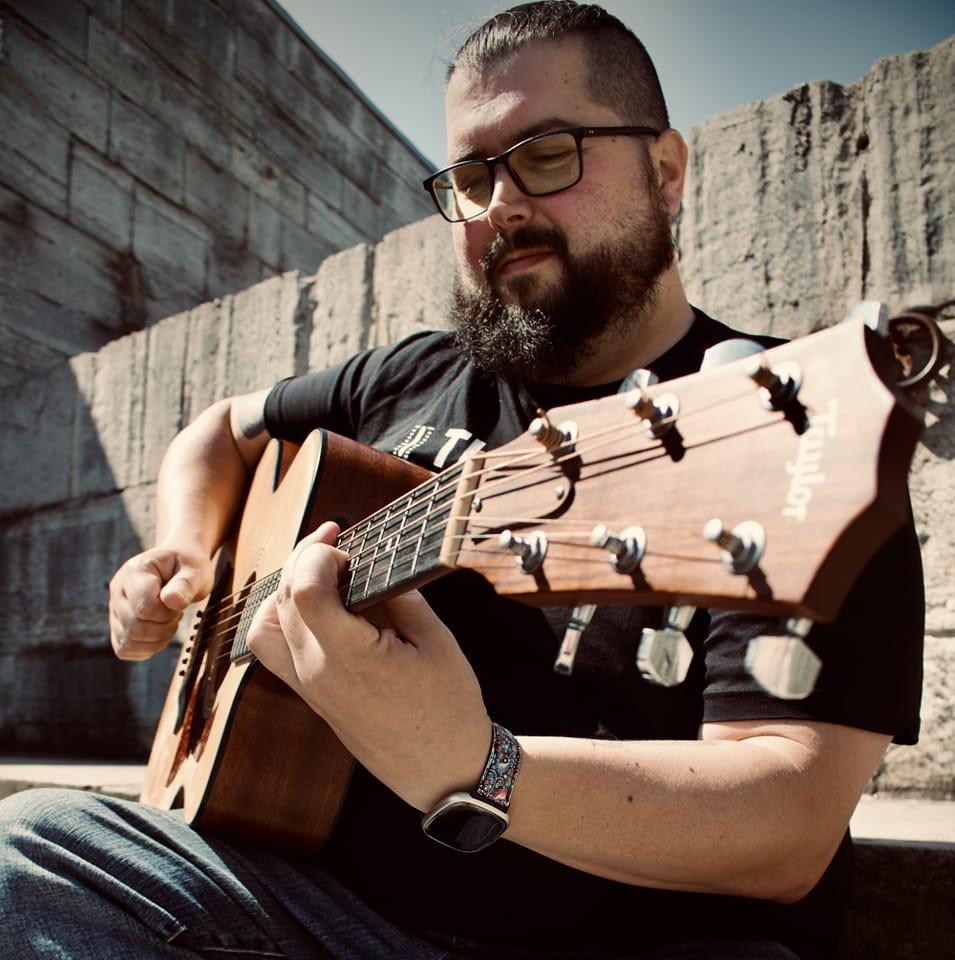
Interview with Jay Munday, ADHD and chronically ill musician. Jay has a new website and can also be found on social media as Jay Munday Music. And can be listened to on Spotify and many other streaming services.
What inspired your journey into music, and was the guitar your first instrument of choice?
The guitar was the first instrument I played. I started playing when I was just getting into secondary school. I was 11 when I first started playing. I started having lessons with a private tutor. There were classes where it was just us, one-on-one, and then there was us with an extra person. It was weird like sometimes you could have two students in one class, but it was meant to be like a private lesson. It was just a weird set-up.
I had private lessons with a brilliant guy named Mac. He helped me learn the basics, and his son then took over when I started to get a bit more advanced. That’s when I went to college and met my music hero and friend Gary Shaw, who opened my eyes to a new world of guitar. College is where it took off.
How does your neurodivergence impact your music learning and playing experience?
I learn very quickly. I think part of my neurodivergence helps with that. I do tend to pick things up incredibly quickly. There are times when I’m a bit monotropic and when I do start to find a new topic or a new theory, I work that to excess, and I will learn it to the point that it’s just muscle memory and I don’t need to think about it.
Have you experienced perfectionism or imposter syndrome?
Massively, especially around songwriting, I had this anxiety about a song being perfect, I needed every lyric to be perfect. It made songwriting such a chore, it was hard work because I put such a high expectation on myself.
I was worried about my lead guitar playing being perfect. I’ve always been good but stressed and worried about my lead playing, I wanted to play the right notes. I was constantly in my head when it came to lead playing. I was so worried about playing a duff note that it took me ages to work up to my first performance. I used to turn up to The Barn (at the Milton Arms), a local music venue and everyone would joke every week when I brought my guitar in “You going to play tonight?”. When I finally got up there, after months of telling people “Yeah, next week” I loved it and didn’t want to come off stage. Now I know that playing a note outside of what is expected can sound great – sometimes you must add the tension to release.
Talking about creating perfect lyrics, what are your lyrics mostly about?
A lot of them are about relationships, not necessarily romantic ones, but relationships with family and people like that. I think you draw on life to create your art. There are elements of my experiences that my songs are about, I get inspiration from my relationship history.
You had quite a long break in your music career, do you want to talk more about that?
The long break was mostly because I had been in a bad place in mental health for quite a while and I realised I’d had anxiety from a very young age. I used the long break to take some time to step away from music and focus on myself. I’d had some things happen in my family and work, including workplace bullying. It all mounted up and I needed to sort myself out and heal. It ended up being quite a long healing process.
I feel my music has benefited from that break and that process of healing. I’m less in my head and less worried about it.
Coming back after a long break, and newly realised being ADHD as well, has that influenced how you create music?
With my ADHD I find it incredibly easy to start new projects but the idea of finishing a project doesn’t fly for me! I’ll have five to eight tracks on the go but getting to finishing one is a real challenge. I think because I’m aware of my ADHD now I’m able to challenge that old way of thinking and make myself finish songs. Not having so much of a perfectionist mentality as well has also helped. I’m forcing myself to just not move on too much.
I can get an idea onto a dictaphone and then I can leave that alone. I don’t need to do it now because it’s not in my head then. I can come back to it. Otherwise, I’ll forget it and then it’s gone. And that’s why I always had numerous projects on the go. Whereas now I can go, “Let’s get that idea down onto paper or a voice recorder so it’s stored for when I’ve got some time. I’m not going to move on until I’ve finished this one.”
How does social media influence your music release schedule and live performances?
There are different trains of thought on this. There’s a guy on social media called Nick D who spent three years realising a new song every two weeks. That kept him in the public attention and kept things fresh as he always had something new he was working on. But there’s an element of not wanting to release music just for the sake of it.
I want to release material that I feel is showcasing what I do to a good level, so I don’t feel pressure in terms of how often I should be posting something or engaging with social media. I’m trying to build a fanbase, keep the public engaged and get as many eyes on my work as possible. My goal isn’t to get to any specific number or goal, my goal is just to get my music out there and heard.
I just want to release material, enjoy it and get it heard by as many people as I can.
How do you connect with other artists?
Fortunately, I work with studios that are connected to lots of different artists as well. I do want to get out and network more by going to other artists’ gigs.
I also play for other musicians which helps. Supporting other’s projects through advertising and social media engagement means they often do the same for me. The music scene in Portsmouth has changed since I took my break. Nine years back everyone was more out for themselves, now there seems to be a real community vibe with local musicians trying to support each other, which is lovely to see.
What do you think the difference is nine years on?
I think everyone knows that it’s a difficult period, especially in the music scene and you’ve got the big streaming services that are trying to bury independent artists. They won’t bury major artists because they’ve got big deals with the major companies which then supports their growth and their money, but it buries the independent artist.
Changes are happening with Spotify now. They’re on about a new tier where listeners can remix and mash up songs directly, which is then leaving artists asking, “If you mash up my song, am I getting any royalties for that? Because now you’re taking my work and changing it.” And can we opt out of that? That’s what we don’t know at this point. Spotify is saying that the digital distributors should be telling you about this, but the digital distributors are changing their terms and agreements and not notifying artists. This amounts to them saying, “We have the right to use and exploit your music”. Again, it’s just burying independent artists.
Music venues are struggling too. You’ve got the Music Venue Trust now, which is trying to build and support those local grassroots music venues to stay alive. I think when you look at all the venues on the Music Venue Trust, I think there was like 40-odd, and I think there’s only nine remaining at this point. So, venues are struggling.
It all comes back down to the artists as well, because then you’ve got nowhere to gig, you’ve got nowhere to release your music. And when you do release your music, they’re changing the specs so that you can’t earn money from releasing your music. I think we’re all starting to go, “We’re all in this together”. It’s been a real change in mentality from that.
Do you have any advice for neurodivergent people going into music?
Wow. It sounds simple but just enjoy it. There are too many other things in this world that are draining your energy, draining your mental state, and that will have a negative impact. Enjoy what you do and release what you want and don’t worry about making music perfect. Just get it out there. Music can be therapy that way.
Is there anyone you’d like to shout out?
Mayfield Studios. I’ve been doing lots of work with them, they’ve got a good house band which I’m part of now and that’s good.
Hatfish Publishers and United Masters. They are both my publishers.
My friend and mentor Gary Shaw.
And my friend Kev Smith of the Foundry studio.