
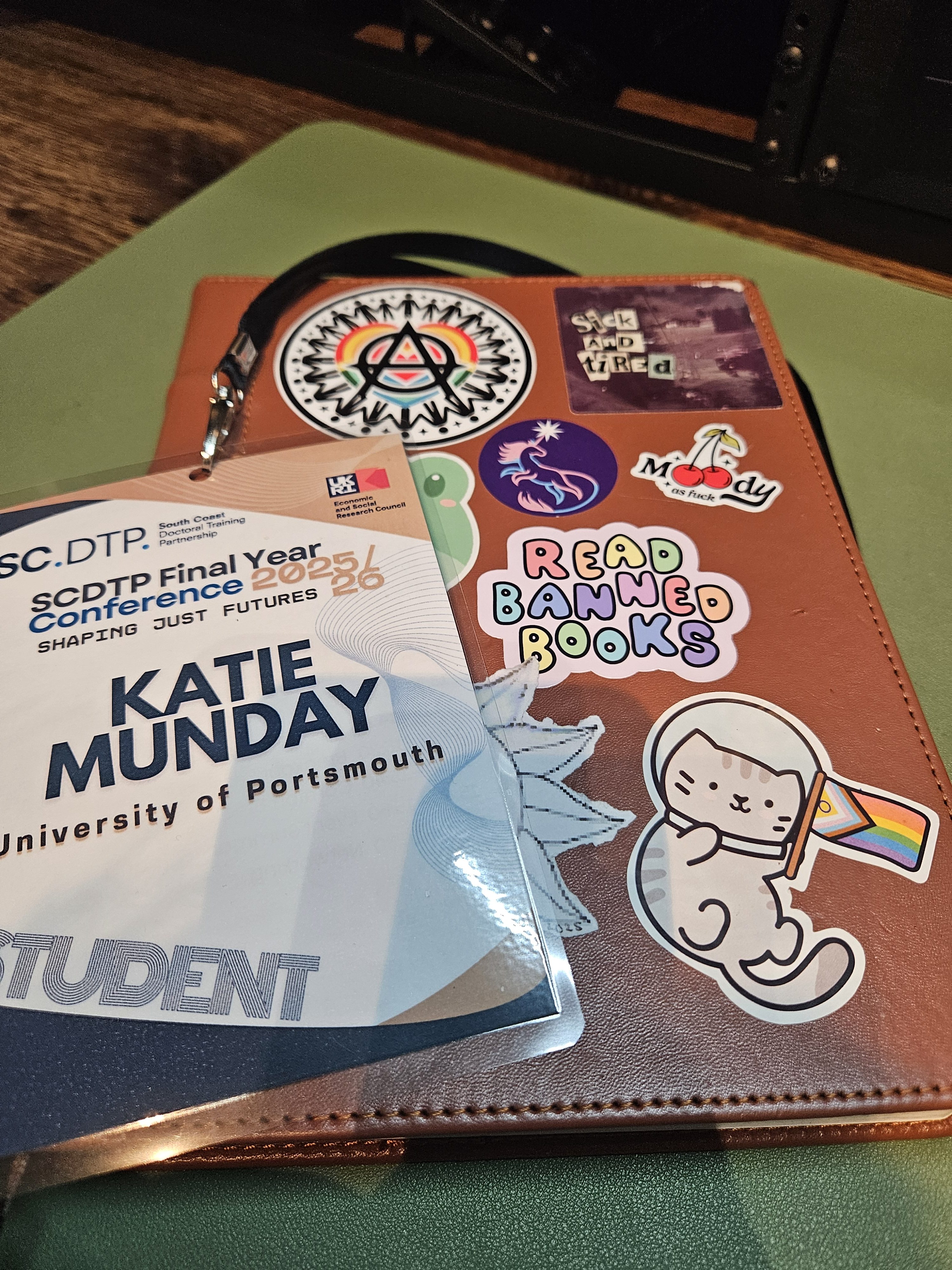
When I go to conferences, and sometimes during informal conversations, I take notes. Not great reams of notes, and they are definitely not detailed (or ordered in any particular manner!). My note taking is based on what inspires me – what grabs me when people speak. My notepads and diaries are filled with amazing things I have been lucky enough to witness over the years.
The recent South Coast Doctoral Training Partnership Final Year Conference 2025 was a day filled with intense scribbling on A4 pieces of paper now filled with gold.
My most furious jotting happened during the key note speeches, two powerful sharings that affirmed my focus for love and connection within research and how social justice means we have to sit in discomfort and curiousity to learn, grown and give grace to ourselves and others.
Dr Maisha Islam shared her experiences of research-activism, including work around racial and religious equity in higher education. She is a co-editor of the recently published book Uncovering Islamophobia in Higher Education:
Supporting the success of Muslim students and staff. My biggest note from Maisha’s talk was “Love is energy ❤️”. I asked how Maisha navigated centering love and connection in the academy, and she replied how she kept in contact with some of her participants, and saw this as an ethical practice to keep connected with Bangladeshi women in academia.
I also enjoyed Maisha’s idea/wording around the “missing professors” who academia spaces don’t recognise or promote. She was referring to Bangladeshi women in academia. I know this effects many groups of women and gender minorities, racialised minorities and those who are both.
Feeling the love from this first session made way for the powerful offerings of Mr Pascal Matthias , the Associate V-P of EDI and Social Justice at University of Southampton. Pascal is also a co founder of FACE (Fashion and the Arts Creating Equity), a network of Black academics challenging racism and anti-Blackness in education and fashion industries, understanding that “wherever anti-Blackness challenge and protocol is centred then all racially minoritised staff and students benefit”. I knew I would likely nod my head vigorously at everything Pascal shared as soon as he said “I don’t really like the term EDI.” Yes, 100%, as a term that was likely created by white, middle-class men to house ‘the other’ but I digress…
Pascal suggested coming to hatred and ignorance with compassion, a difficult thing to do in the academy for sure. My favourite scribblings from his presentation were his words: “compassion is intellectual moral courage”, “where there are difficulties there are opportunities” and “sitting in the struggle” (I believe his grandmother used to say this in Sierra Leone). I also loved drawing a pair of trousers when he made the off-the-cuff metaphor for a right/only way of sewing trousers with a sewing machine (inseams first, then the outseams), as a way to talk about the re/production of oppressive and harmful language within oppressive and harmful structures that cannot be dismantled by these words or structures.

Theses keynotes were followed be some energising talks from final year PhD candidates. I especially loved Mrs Khaleda Brophy-Harmer (strange to talk about her so formally but I’ve done it with everyone else in this blog!). Khaleda shared her work entitled Mass-Observing Whiteness: Understanding performances of race in the Mass Observation Archive, 1990 – 2000. It was really fascinating hearing her talk of her two case studies, focusing on the re/creation and of whiteness, considering whiteness is often spoken about for what it is not as apposed to what it is. My notes for this talk include the word “sticky”, “fragmented, chaotic productions” and the question “how can we listen more carefully?”
All-in-all the #SCDTPFYC2526 was a marvelous constellation of transformative research and researchers. The organising committee did an amazing job, I know there was a lot to think of, organise and a lot of rushing around and just before winter holidays no less! This was a space to ask the really important questions of who gets to create knowledge, who is rewarded for their knowledge creation and how we tackle these inequities without being consumed by rage.